




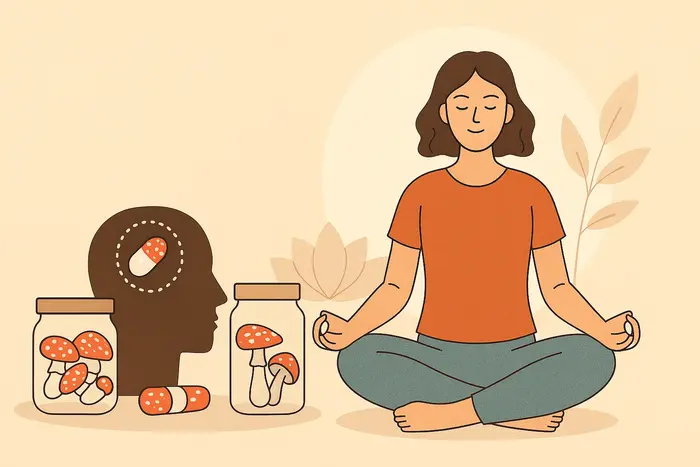
Combining Amanita muscaria microdosing with meditation enhances the practice by amplifying GABA-mediated relaxation, deepening interoceptive awareness, reducing mental chatter, and facilitating sustained present-moment focus during mindfulness and breathwork sessions.
Amanita muscaria microdosing and meditation are a natural combination that works harmoniously at the level of the body and mind. Both practices target the same neurological goal: reducing the noise floor of the nervous system so that attention can settle into present-moment experience rather than constantly chasing or reacting to the next stimulus. If you approach them with respect and understanding, they become a mutually reinforcing tool for self-knowledge and calm.
This article explains why the combination works from a neuroscience perspective, how to structure sessions for maximum benefit, what different meditation styles pair best with microdosing, how to integrate the experience over time, and — crucially — what not to expect, so the practice stays grounded in reality rather than inflated expectations.
The neuroscience of synergy between microdosing and meditation
A controlled study by Streeter et al. (2010, J Altern Complement Med, PMID 20722471) found that a 60-minute yoga session increased GABA levels in the brain by 27% compared to a matched walking session. This GABA increase correlated with improved mood and reduced anxiety. The finding establishes a direct biochemical mechanism for why contemplative practices produce their calming effects — not just relaxation as a vague concept, but measurable shifts in the brain's primary inhibitory neurotransmitter system.
Muscimol, the active compound in Amanita muscaria, is a direct GABA-A receptor agonist (Johnston, 2014, Neurochem Res, PMID 24525044). It binds the same receptors that endogenous GABA targets, producing similar inhibitory effects through a pharmacological route. The convergence of these two pathways — meditation's endogenous GABA lift and muscimol's GABA-A agonism — creates a compounding effect: you're supporting the inhibitory system from two directions simultaneously.
The practical result is that entering a meditative state feels less effortful. The usual 10–15 minutes of mental settling that most people require before any genuine depth of practice becomes available tends to compress to 3–5 minutes on microdose-supported sessions, according to user reports. That compression matters most for people who struggle to maintain sitting practice — for whom those first difficult minutes are often what prevents the session from happening at all.
Why meditation is harder with ADHD or chronic anxiety
For people with ADHD, the standard advice to "just sit and breathe" runs directly into the disorder's core features. The ADHD brain doesn't idle well. Time blindness makes session length feel arbitrary and uncertain. Restlessness — both mental and physical — is a neurological feature, not a failure of willpower. The amygdala hyperreactivity that drives emotional dysregulation in ADHD also produces a constant background of low-level alertness that meditation is supposed to quiet but which, in ADHD, is functionally difficult to reduce through intention alone.
Chronic anxiety produces a similar barrier through different mechanisms: hypervigilance, rumination, a body that stays tensed even when the mind tries to relax. Body-scan meditations — which direct attention systematically through physical sensations — can paradoxically increase anxiety when the body's baseline tension is high enough to feel threatening when attended to closely.
Muscimol's GABA-A agonism addresses both barriers at the neurological level. By raising inhibitory tone in amygdala circuits (reducing threat reactivity) and in prefrontal circuits (supporting attentional stability), it creates a more receptive baseline for meditation to work from. The person doesn't have to fight their own nervous system to get into the practice — the practice gets a clearer starting point.
How muscimol changes the meditation entry point
The typical meditation session begins in ordinary waking consciousness and progresses through a settling phase — the period in which the mind stops chasing thoughts and begins to rest in the present. For most beginners, and for many experienced meditators dealing with ADHD or anxiety, this settling phase is the hardest part. It's where most sessions quietly fail: the mind never quite settles, the session ends before anything meaningful happens, and motivation to try again decreases.
Microdosing Amanita muscaria before meditation appears to pre-reduce the friction in this settling phase. Users describe the transition from ordinary waking mind to meditative depth as happening earlier, with less effort, and with a qualitatively different quality — less like fighting toward stillness and more like stillness arriving. The internal experience is typically described as warmth, lightness, and a gentle slowing of mental traffic rather than any dramatic perceptual shift.
This isn't the same as the meditative states that arise from years of disciplined practice. It's more like having a calmer starting position — which is particularly valuable when the starting position has habitually been chaos. From a calmer starting position, the meditation can actually do what it's designed to do.
What you feel during combined practice
During meditation in a state of microdosing, a feeling of warmth, lightness, and slowing of time often appears. Thoughts become softer, internal criticism quiets, and a calm perception of the present moment becomes easier to access and maintain. Some describe this as pure presence — when the sense of the body relaxes, and the mind observes without judgment or agenda.
The quality of breath awareness typically deepens. Interoceptive perception — the ability to sense internal body states — often becomes more available, which supports body-scan and mindfulness-of-sensation practices specifically. Pain and tension in the body remain noticeable, but the reactive layer — the mental labeling and resistance — tends to be lower, making equanimity toward physical sensation more accessible than usual.
What's notably absent is what people sometimes expect from any "mushroom" context: visuals, perceptual distortions, euphoria, or dissociation. None of these occur at microdose levels. The effect is subtle enough that many users only recognize it in contrast — when they meditate without the microdose and find the practice noticeably harder to settle into.
Matching meditation style to microdosing
Different meditation styles pair differently with the microdosing state. The table below reflects user-reported preferences rather than clinical evidence:
| Meditation style | Best timing | Dose | Why it pairs well |
|---|---|---|---|
| Mindfulness of breath (Vipassana-adjacent) | T+30–45 min after dose | 0.1g dried / 1 capsule | Reduced mental chatter supports sustained breath focus; fewer intrusive thoughts to manage |
| Body scan / progressive relaxation | T+45–60 min | 0.05–0.1g | Heightened interoception + reduced amygdala reactivity allows body tension to be noticed without escalating anxiety |
| Yoga nidra (evening wind-down) | T+45–60 min, evening | 0.05g | Muscimol's mild sedative tendency at evening timing supports the hypnagogic transition this practice targets |
| Open awareness / choiceless awareness | T+30–60 min | 0.1g | Reduced mental noise makes the "background awareness" that this practice points to easier to access and sustain |
How to integrate the experience
After practice, give yourself 10–15 minutes of quiet before returning to ordinary activity. Write short notes about what you noticed — this helps track changes over time and builds the self-knowledge that makes microdosing a genuine practice tool rather than just a pleasant state. Pay attention not only to the moment of meditation itself, but to your general emotional tone throughout the day: less anxiety, more clarity, greater ease in interpersonal situations. Microdosing is not the destination — it's a tool that supports the practice, which is the destination.
Over weeks, most regular practitioners report a carry-over effect: the calmer baseline established on dose days begins to influence non-dose days as well. The meditation practice itself deepens as skill accumulates. The combination creates a reinforcing loop: better meditation supports nervous system regulation; better nervous system regulation makes the meditation easier and more productive; consistent practice produces lasting neurological changes that extend beyond any individual session.
What not to expect
Do not expect visions, bright effects, or an obviously psychedelic experience. Amanita muscaria at microdose levels (0.05–0.15g of dried preparation) does not produce perceptual distortion. This is subtle work with the inner state — the kind of work that doesn't produce dramatic peak experiences but does, over time, produce lasting changes in how available stillness feels.
Don't meditate on an empty stomach, and not immediately after a heavy meal — a light meal 60-90 minutes before the session tends to work well. Provide a calm, safe environment where no one will distract you. Remember that stability and sincerity are more important than session duration. A consistent 15-minute practice will produce more lasting change than occasional long sessions that happen sporadically.
Important tips for the combined practice
Start with shorter sessions (15–20 minutes) rather than ambitious long sits. The combination reduces the activation cost of practice, which can make it tempting to extend sessions — but the goal is sustainability and integration, not peak experiences. Build duration gradually over weeks.
Keep a practice log from day one. Note the time of dose, time of session start, session type, and a brief note on quality. After four weeks, the pattern of what works for you individually will become much clearer — dose timing, session type, duration, and combination with other practices.
Conclusion
Combining microdosing of fly agaric with meditation is a path toward deep peace, self-knowledge, and natural harmony. Fly agaric helps relieve tension, and meditation helps to realize the silence that remains within. When these two practices work together, they create a space in which the mind, body, and nervous system sound in unison. The combination works best when approached with patience, consistency, and the understanding that the work is gradual — and that gradual is exactly what lasting change looks like.You can check out our premium fly agaric products to support your health:1. Fly Agaric Capsules — convenient and precisely dosed for daily balance.
2. Fly Agaric Extract — a powerful, fast-absorbing formula for relaxation.
3. Fly Agaric Powder — a pure, versatile form for specialty blends and teas.Learn more at Amanita Muscaria Store — certified quality and fast delivery to the EU.
Frequently Asked Questions
Does Amanita muscaria microdosing produce any psychedelic effects during meditation?
No — at true microdose levels (0.05–0.15g of dried preparation), Amanita muscaria does not produce perceptual distortions, visuals, or altered states. The effect is entirely sub-perceptual: a reduction in mental chatter, mild physical relaxation, and a somewhat softer entry into meditative depth. Users who expect psychedelic effects are consistently surprised by how subtle the experience is. This subtlety is actually what makes it useful for daily meditation practice — you can function normally and maintain the clarity that meditation requires.
How long should I wait after taking the microdose before starting meditation?
Most users report the best results starting their meditation session 30–45 minutes after taking the dose. This allows the initial digestion and absorption phase to pass and aligns with the period of peak GABA-A modulation. Starting too early (under 20 minutes) often means the effect hasn't established yet; starting too late (over 90 minutes) means you're past the peak window. Experiment within the 30–60 minute range initially and adjust based on what you observe in your own practice.
Is this combination appropriate for complete meditation beginners?
Yes, and in some ways it's particularly useful for beginners because it reduces the most common barrier to establishing a practice: the frustrating settling phase where the untrained mind refuses to quiet. That said, beginners benefit most from keeping sessions short (15–20 minutes), maintaining a consistent schedule, and tracking what they notice rather than expecting dramatic results. The combination is a support for practice, not a replacement for the patience and repetition that build meditation skill over time.
Can I combine fly agaric microdosing with guided meditation apps or teachers?
Yes — the combination works well with any structured guidance. Guided body scans, breath-awareness sessions, and yoga nidra recordings all pair naturally with the microdosing state. The key is to use the guidance as intended: to direct attention, not to create a particular experience. Many people find that voices they previously found distracting in meditation become easier to follow and settle into on microdose days, which is consistent with the reduced reactivity and improved attentional stability that muscimol's GABA-A effects produce.
What happens if I meditate without the microdose after weeks of combined practice?
Most regular practitioners report that the meditation skill acquired during microdose-supported sessions transfers to non-supported sessions over time. The GABA-mediated calming that felt "given" by the mushroom begins to feel more accessible through the practice itself — consistent with research showing that sustained meditation practice produces lasting increases in baseline GABA tone (Streeter et al., 2010). Some people use the microdose as a training wheel that they gradually need less as the practice matures; others continue using it indefinitely as a consistent support.
Related Articles
- How Amanita muscaria Helps with Anxiety
- How to Calm the Mind with Amanita muscaria
- Improving Sleep with Amanita muscaria
- How Amanita muscaria Supports Nervous System Balance
- How to Start Taking Amanita muscaria Safely
Sources
- Streeter CC, et al. Effects of yoga versus walking on mood, anxiety, and brain GABA levels. J Altern Complement Med. 2010. PMID 20722471
- Johnston GAR. Muscimol as an ionotropic GABA receptor agonist. Neurochem Res. 2014. PMID 24525044
- Michelot D, Melendez-Howell LM. Amanita muscaria: chemistry, biology, toxicology, and ethnomycology. Mycological Research. 2003. PMID 12733432
- Tsujikawa K, et al. Analysis of hallucinogenic constituents in Amanita mushrooms. Forensic Sci Int. 2006. PMID 16442251
- Abdou AM, et al. Relaxation and immunity enhancement effects of gamma-aminobutyric acid (GABA) administration in humans. Biofactors. 2006. PMID 16971751