




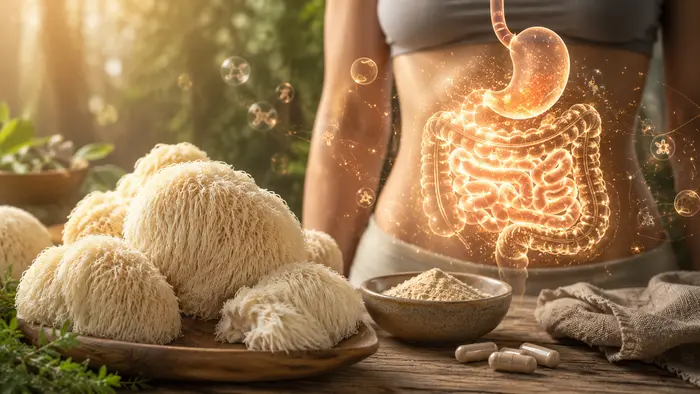
Lion's mane improves digestive health by promoting growth of beneficial gut bacteria, reducing gastric mucosal inflammation, stimulating enteric nervous system repair via NGF, and showing protective effects against H. pylori-associated gastric ulcers in preclinical research.
Many people suffer from digestive disorders — constipation, bloating, flatulence, abdominal discomfort — caused by stress, poor diet, sedentary lifestyle, or gut dysbiosis. Lion's mane addresses digestive health through several distinct mechanisms that are more specific and better-researched than most functional food claims.
How Lion's Mane Polysaccharides Feed Beneficial Bacteria
The primary digestive mechanism of lion's mane involves its beta-glucan polysaccharides acting as prebiotic fibers. Research using an artificial gastrointestinal model found that after passing through simulated stomach acid and small intestine enzymes, lion's mane polysaccharides remained largely intact — reaching the colon where they were fermented by beneficial bacteria.
This fermentation process selectively promoted growth of Lactobacillus and Bifidobacterium species while suppressing potentially harmful bacteria. As a byproduct, the fermentation produced short-chain fatty acids (SCFAs) — primarily butyrate, acetate, and lactate. Butyrate is particularly important: it's the primary energy source for colonocytes (colon lining cells), has potent anti-inflammatory effects, strengthens the gut barrier, and has been studied for its role in reducing colorectal cancer risk. A well-nourished gut microbiome also produces substantially more serotonin — around 90% of the body's total — which connects digestive health directly to mood and sleep quality.
Gastric Ulcer Protection and H. pylori
One of the more specific digestive benefits studied in lion's mane is gastroprotection against ulcers. Animal research published in the Journal of Agricultural and Food Chemistry (2015, PMID 26244378) found that Hericium erinaceus extract significantly reduced gastric ulcer formation in ethanol-treated rats, protecting the gastric mucosa from oxidative damage.
Separate research investigated lion's mane's effects against Helicobacter pylori (H. pylori) — a bacterium that colonizes the stomach lining and is a major cause of gastric ulcers and gastric cancer. In vitro studies found that Hericium erinaceus polysaccharides inhibited H. pylori adhesion to gastric epithelial cells, reducing the bacterium's ability to establish infection. This doesn't replace H. pylori medical treatment (antibiotics remain the standard), but it suggests lion's mane may support gastric mucosal health in people with chronic digestive inflammation.
Gut Lining Repair and Leaky Gut
One of the lesser-known digestive benefits of lion's mane is its potential to support the integrity of the gut lining. Research has shown that certain bioactive compounds in Hericium erinaceus help repair and strengthen the tight junctions of the intestinal epithelium — the cells that form the gut's first line of defense against pathogens and toxins.
A compromised gut lining (sometimes called «leaky gut» or increased intestinal permeability) allows bacteria, endotoxins, and partially digested proteins to enter the bloodstream, triggering systemic inflammation and immune activation. This process is implicated in IBS, IBD, food sensitivities, autoimmune conditions, and even mood disorders via the gut-brain axis. By supporting a healthier gut barrier, lion's mane may help reduce symptoms in people with chronic digestive discomfort that hasn't fully responded to dietary changes alone.
NGF and the Enteric Nervous System
A less commonly discussed digestive benefit relates to lion's mane's NGF-stimulating properties. The gut has its own extensive nervous system — the enteric nervous system (ENS), sometimes called the «second brain» — containing roughly 100–500 million neurons that coordinate digestive motility, secretion, and sensation. NGF plays an important role in maintaining ENS neuron health.
Because lion's mane stimulates NGF synthesis through hericenones and erinacines (Mori et al., 2008, PMID 18296328), it may support enteric nerve health alongside its better-known central nervous system effects. This could partially explain why some users report improvements in gut motility and reduced IBS symptoms — the ENS neurological component of gut function is being supported alongside the microbiome one.
Lion's Mane and IBD Research
Inflammatory bowel disease (IBD) — including Crohn's disease and ulcerative colitis — involves chronic gut inflammation driven by immune dysregulation. Several animal studies have tested lion's mane polysaccharides in colitis models. A 2016 study found that Hericium erinaceus extract significantly reduced colitis severity scores, decreased pro-inflammatory cytokines (TNF-α, IL-6, IL-1β) in colon tissue, and improved colon mucosal integrity in mice with DSS-induced colitis.
Human IBD data doesn't yet exist for lion's mane specifically, so these findings are preliminary. However, the anti-inflammatory mechanisms are consistent with the broader polysaccharide literature, and the safety profile of lion's mane is well established — making it a reasonable complementary consideration for people with IBD who are already under medical supervision.
| Digestive benefit | Mechanism | Evidence level | |---|---|---| | Prebiotic effect | Beta-glucans feed Lactobacillus/Bifidobacterium | Animal + in vitro | | Gastric ulcer protection | Mucosal antioxidant, anti-inflammatory | Animal studies | | H. pylori inhibition | Adhesion inhibition | In vitro | | Gut lining repair | Tight junction support | Animal studies | | Motility support | ENS NGF stimulation | Preclinical (plausible) | | IBD symptom reduction | Cytokine inhibition in colon | Animal models |How to Add Lion's Mane to Your Diet for Digestive Health
For digestive health specifically, consistency matters more than timing. Taking 1–2 g daily with meals is a sensible starting point. Pairing lion's mane with a fiber-rich diet and adequate hydration creates the most supportive environment for the prebiotic effect — the beta-glucans need fermentable substrate already present in the colon to deliver their benefit fully.
Most users begin noticing improvements in digestive comfort and regularity within 2–3 weeks of consistent use. Full microbiome remodeling takes longer — 4–8 weeks for measurable shifts in microbial community composition. Lion's mane can be consumed as tea, blended into smoothies, added to soups, or taken as daily capsules depending on preference.
You can find lion's mane products in our store:
1. Lion's mane fruits
2. Lion's mane capsules
3. Lion's mane extract
Frequently Asked Questions
How long does lion's mane take to improve digestion?
Most users report improvements in digestive comfort — reduced bloating, more regular bowel movements, less abdominal discomfort — within 2–3 weeks of consistent daily use. Full microbiome remodeling (measurable changes in gut bacteria composition) takes 4–8 weeks. The gut lining repair and ENS neurogenic effects are slower still, typically evident over 8–12 weeks of continuous supplementation with a supportive high-fiber diet.
Can lion's mane help with IBS symptoms?
There are no human clinical trials specifically testing lion's mane for irritable bowel syndrome (IBS). However, the mechanisms are relevant: IBS often involves gut dysbiosis, increased intestinal permeability, and low-grade gut inflammation — all areas where lion's mane has demonstrated preclinical benefit. Its prebiotic beta-glucans, gut-lining support, and anti-inflammatory effects make it a biologically plausible adjunct to an IBS management plan. Consult your gastroenterologist before adding supplements to an IBS regimen.
Does lion's mane help with acid reflux or GERD?
No direct human data exists for lion's mane and acid reflux or GERD. The gastroprotective effects shown in ulcer models involve mucosal protection rather than reducing acid production, so it's unlikely to replace proton pump inhibitors or H2 blockers for acid-related conditions. That said, its anti-inflammatory and gut-lining support properties are not harmful to the upper GI tract. If you have GERD, discuss supplementation with your doctor before starting.
Is lion's mane a probiotic or a prebiotic?
Lion's mane is a prebiotic — it feeds existing beneficial bacteria in your gut rather than introducing new bacterial strains. Its beta-glucan polysaccharides reach the colon largely intact and are fermented by Lactobacillus and Bifidobacterium, selectively promoting their growth and SCFA production. It doesn't contain live bacteria itself. For best results, combine it with probiotic-rich fermented foods (yogurt, kefir, kimchi) to provide both the bacteria and their preferred food source.
Can I take lion's mane if I have an inflammatory bowel disease like Crohn's or ulcerative colitis?
Animal studies show lion's mane polysaccharides reduce colitis severity and pro-inflammatory cytokines in IBD models. No human IBD trials exist yet. The safety profile of lion's mane is well established, and its mechanisms are compatible with IBD management goals. However, IBD is a medically managed condition — always inform your gastroenterologist before adding any supplement, as some may interact with immunosuppressive medications commonly used in IBD treatment.
Related Articles
- Lion's mane Benefits
- Lion's mane for Fatigue
- Lion's Mane for Parkinson's Disease
- Lion's Mane for Stroke Recovery
- Lion's Mane for Alzheimer's
- Lion's Mane for Menopause Brain Fog
- Lion's Mane for Sciatic Nerve Damage Treatment
Sources
- Mori K, et al. Nerve growth factor-inducing activity of Hericium erinaceus. Biol Pharm Bull. 2008. PMID 18296328
- Lai PL, et al. Neurotrophic properties of the Lion's mane medicinal mushroom. Int J Med Mushrooms. 2013. PMID 24266378
- Wang M, et al. Hericium erinaceus polysaccharides induce changes in the gut microbiota. J Sci Food Agric. 2019. PMID 31168819