




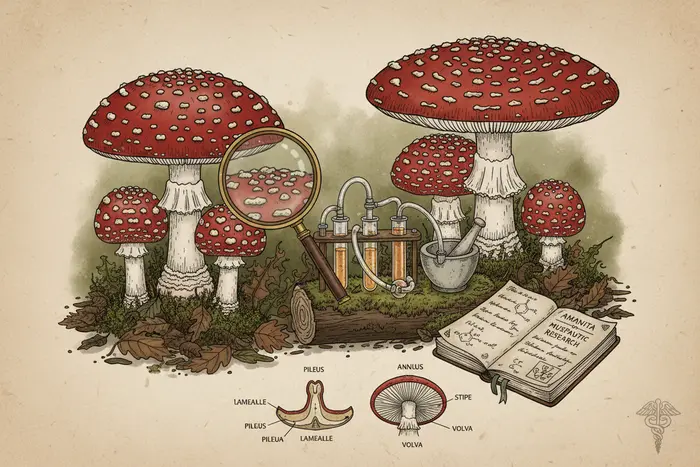
Amanita muscaria compounds, particularly muscimol's neuroprotective GABA-A activity, may support post-stroke recovery by reducing excitotoxic neuronal damage, limiting ischemic injury progression, and facilitating neuroplasticity — but this is preclinical research only, not an established human treatment.
What happens in the brain during a stroke
A stroke disrupts the brain's blood supply, and within minutes oxygen-starved neurons begin to die — partly through "excitotoxicity," a flood of the excitatory neurotransmitter glutamate that overwhelms cells. Much stroke research targets exactly this cascade, which is where a calming, inhibitory compound like muscimol becomes theoretically interesting (Johnston, 2014, Neurochem Res, PMID 24525044). After a stroke, many people face lasting difficulties with movement, speech and cognition, and rehabilitation medicine is always searching for ways to limit the initial injury and support recovery. Muscimol has been examined in that research context — but examined is the key word, and it is a long way from the clinic.Muscimol and GABA: the proposed neuroprotective idea
The reasoning is mechanistic. Muscimol is a strong agonist of GABA-A receptors — GABA being the brain's main inhibitory neurotransmitter — while glutamate is the main excitatory one. In a stroke, excess glutamate damages neurons. By increasing inhibitory tone, muscimol could, in principle, counterbalance that over-excitation and reduce further harm.Animal and cell-based studies have explored this idea, with some reporting that muscimol given after an experimental ischemic injury reduced the extent of brain-tissue damage and was associated with better recovery of function. These are preclinical findings in controlled experiments, not results from human patients, and the specific magnitudes reported in individual animal studies should not be read as expected human outcomes. The direction of the research is genuine; the clinical conclusion is not yet there.The proposed mechanism, in plain terms
The table summarises the steps researchers have looked at — and, importantly, the status of each. The mechanism is plausible; the human treatment is not established.| Step | What preclinical research has explored | Status |
|---|---|---|
| GABA-A activation | Muscimol hyperpolarises neurons, lowering excitability | Established mechanism |
| Reduced excitotoxicity | Counters the glutamate surge that kills cells | Animal / cell models |
| Less calcium influx | Limits a key driver of neuronal death | Preclinical |
| Reduced swelling | Lower tissue water content in animal models | Preclinical |
| Human stroke recovery | Not tested in clinical trials | NOT established |
What the preclinical studies looked at
In animal models of ischemic injury, researchers have reported several measures said to improve with muscimol: histological signs of less neuronal damage, reduced release of excitatory glutamate, faster recovery of motor function, and less brain swelling. Separately, cell-based work has examined muscimol's ability to limit damage from over-activation of NMDA receptors — a process related to the cell death seen in stroke — using markers such as lactate dehydrogenase release.Each of these is a legitimate line of inquiry, and together they explain why muscimol appears in neuroprotection research at all. But none of it amounts to evidence that consuming fly agaric helps a person recover from a stroke. Laboratory neuroprotection and a safe, effective human therapy are separated by years of careful trials that simply have not been done here.Why this is not a treatment — and why caution is essential
This point cannot be overstated. Stroke is a medical emergency in which every minute of delay costs brain tissue, and the proven response is immediate professional care. Fly agaric is not an approved stroke treatment, has never been tested for that use in humans, and is itself toxic when improperly prepared or dosed. Using it in place of, or alongside, emergency or rehabilitation care without a physician's involvement could be dangerous — both directly and by delaying real treatment. The honest takeaway is that muscimol is an interesting molecule for neuroscience research, and that interest says nothing about what an individual should do after a stroke. That decision belongs entirely to qualified medical professionals.From the lab to a person: the gap that matters
Why be so insistent on the distinction between research and treatment? Because the history of stroke medicine is full of compounds that protected neurons beautifully in animals and then failed, or even harmed, in human trials. Biology in a dish or a rodent is simpler and more controlled than a human stroke, where age, timing, other illnesses, and drug interactions all shape the outcome. A neuroprotective signal is a reason to run careful, staged clinical trials — first for safety, then for effectiveness — not a green light to use a substance. For muscimol and fly agaric specifically, those human trials have not happened. So the responsible position is not pessimism about the science but precision about its stage: promising mechanism, no proven human benefit, and a toxic mushroom that has no business being part of anyone's stroke care without a doctor. Holding that line protects people far better than an optimistic headline ever could.Conclusion
The link between fly agaric and stroke is a story about a research mechanism, not a remedy. Muscimol's action on GABA-A receptors gives a real, plausible reason scientists have studied it for neuroprotection against excitotoxic damage, and preclinical results have been encouraging enough to justify further study. But "encouraging in animals" is not "safe and effective in people." Until rigorous human trials exist — and none do — fly agaric should be regarded strictly as a subject of research, never as a stroke therapy. Anyone affected by stroke should rely on emergency services and a qualified medical team.You can also buy them in our store.1.Amanita fruits
2.Amanita capsules
3.Fly agaric extract
4.The fly agaric
Frequently Asked Questions
Can fly agaric help you recover from a stroke?
There is no human evidence that it can. Its compound muscimol has been studied in laboratory and animal models for neuroprotection, but those are early-stage experiments, not clinical results. Fly agaric is not an approved or tested stroke treatment in people. Stroke recovery should be managed entirely by medical professionals, and the mushroom should not be used for that purpose.
Why is muscimol studied in stroke research at all?
Because of its mechanism. Stroke damages neurons partly through excitotoxicity — a surge of excitatory glutamate. Muscimol activates inhibitory GABA-A receptors, which in theory could counterbalance that over-excitation and reduce further damage. This makes it a reasonable molecule to investigate in models of brain injury, but a plausible mechanism is a starting point for research, not proof of a human benefit.
What did the animal studies actually show?
In experimental ischemic-injury models, researchers have reported less neuronal damage, reduced glutamate release, faster motor recovery, and less brain swelling with muscimol. Cell studies have also examined reduced NMDA-related cell death. These are preclinical findings in controlled conditions, and the specific numbers from individual animal experiments should not be taken as expected outcomes for people.
Is it safe to take fly agaric after a stroke?
No — and it could be dangerous. Stroke is a medical emergency requiring immediate professional care, and fly agaric is toxic when improperly prepared or dosed. Using it instead of or alongside real treatment without a physician could cause direct harm or delay life-saving care. Never self-treat a stroke or its recovery with fly agaric; follow your medical team's guidance.
What should I do if I think someone is having a stroke?
Call emergency services immediately. Remember the warning signs: sudden face drooping, arm weakness, or speech difficulty — act fast, because rapid treatment dramatically affects outcomes. Do not wait, and do not attempt any home remedy. Stroke care is time-critical and must be handled by emergency medical professionals; nothing in this article substitutes for that.
Related Articles
- Amanita muscaria Microdosing Guide
- Amanita muscaria Effects and Safety
- How to Use Amanita muscaria Tincture
Sources
- Michelot D, Melendez-Howell LM. Amanita muscaria: chemistry, biology, toxicology, and ethnomycology. Mycological Research. 2003. PMID 12733432
- Tsujikawa K, et al. Analysis of hallucinogenic constituents in Amanita mushrooms. Forensic Sci Int. 2006. PMID 16442251
- Johnston GAR. Muscimol as an ionotropic GABA receptor agonist. Neurochem Res. 2014. PMID 24525044