




This comprehensive guide covers everything you need to know about Amanita pantherina, from its active compounds to safe and effective usage protocols.
Key features at a glance
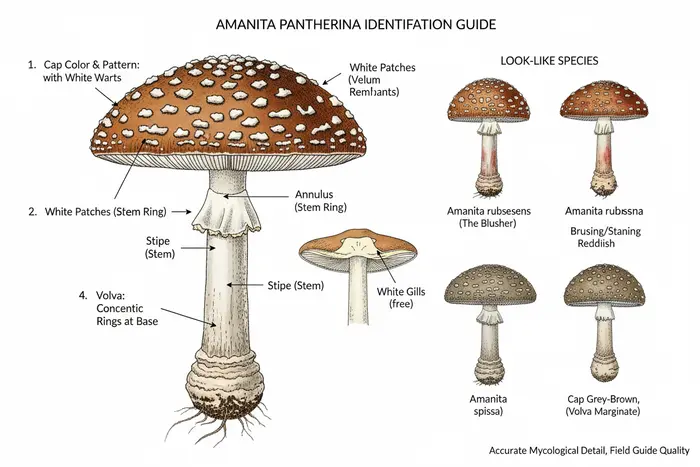
Identification is never about a single trait. The table below summarises the characters experienced foragers assess together, and how panther cap differs from the better-known Amanita muscaria — but field markers alone never make a meal safe, and this guide is for identification awareness, not foraging-for-consumption advice (Michelot & Melendez-Howell, 2003, Mycological Research, PMID 12733432).| Feature | Amanita pantherina | Amanita muscaria | Caution |
|---|---|---|---|
| Cap colour | Brown to olive-brown | Red to orange-red | Brown look-alikes from other genera exist |
| Warts | Pure white, clean | White/yellow-tinged; may stain when removed | Rain can wash warts off entirely |
| Gills | Free, crowded, white | Free, crowded, white | Not distinctive on its own |
| Ring (annulus) | Skirt-like, mid-stipe | Skirt-like, mid-stipe | Lost in damaged specimens |
| Stem base / volva | Distinct, often rimmed (marginate) bulb | Volva present, less clearly rimmed | Must expose the full base to assess |
| Smell | Earthy, unremarkable | Earthy, unremarkable | No pleasant anise/almond note |
Main visual markers
Panther cap usually has a brown to olive-brown cap with white wart-like remnants, a white stem, and a distinct ring. The bulb at the base can show clear concentric margins. Cap color and surface can change with weather and age, so never rely on one trait only. A specimen that looks textbook in dry weather can look completely different after rain has stripped its warts, which is exactly why single-character matching is unsafe.Habitat and season clues
Amanita pantherina commonly appears in temperate forests, often near coniferous and mixed woodland zones, fruiting from summer into autumn. Like its relatives it is mycorrhizal, forming a symbiosis with tree roots, so it is found in association with particular trees rather than scattered at random. Habitat and season help narrow possibilities but are never enough for a safe decision. Always combine ecological context with full morphology from cap to stem base.Dangerous look-alikes
Panther cap can be confused with other brown-capped Amanita and even some non-Amanita mushrooms by inexperienced collectors. Misidentification risk rises when specimens are old, damaged, or incomplete. If the base is not fully visible, identification is unreliable. The most dangerous confusions are with brown-capped edibles from unrelated genera, because a forager expecting an edible may not even consider that an Amanita is on the table — and that single assumption is how serious poisonings begin.Field safety protocol
Do not collect unknown Amanita species for consumption. Photograph mushrooms in place, including cap, gills, stem, and full base. Avoid guessing from online photos alone. If there is any doubt, do not use the specimen. Children and pets are especially vulnerable, so remove unidentified mushrooms from home gardens carefully.Toxicity warning signs
Symptoms can include nausea, vomiting, confusion, agitation, disorientation, and impaired coordination, with severe cases progressing to delirium or seizures (Satora et al., 2005, Toxicon, PMID 15904716). If poisoning is suspected, contact emergency services or poison control immediately and provide full context of exposure, including what was taken and when.Conclusion
Amanita pantherina identification requires strict discipline and full-character assessment, not quick visual matching. In mushroom safety, uncertainty always means stop.Amanita Pantherina Toxicology: What Makes It Dangerous
Key Findings
Amanita pantherina contains the same primary active compounds found in Amanita muscaria — ibotenic acid and muscimol — but typically in significantly higher concentrations. This makes panther cap considerably more potent and more dangerous than Amanita muscaria in terms of toxic dose threshold. Ibotenic acid acts as a glutamate receptor agonist and produces excitotoxic effects at higher doses, contributing to the neurological symptoms — confusion, disorientation, agitation, and impaired motor coordination — that characterize severe Amanita pantherina intoxication. Muscimol, while responsible for the GABAergic sedative effects, can also cause serious CNS depression at the doses present in panther cap. The combined effect is unpredictable and can vary substantially between individuals and specimens.The Most Dangerous Identification Errors
Scientific Background
The risk of misidentifying Amanita pantherina comes from several directions. Brown-capped Amanita species vary significantly in appearance depending on weather conditions, age, and habitat. Rain can wash warts from the cap, making warted species appear wart-free. Young button-stage specimens have not yet developed the mature cap, gill, or ring characteristics that experienced foragers rely on. Dried or damaged specimens lose color and texture cues. Perhaps most dangerously, some brown Amanita pantherina specimens can superficially resemble edible brown-capped mushrooms from unrelated genera, making casual visual matching a genuinely risky approach for any forager without systematic training.Key Distinguishing Features in the Field
Experienced identification of Amanita pantherina requires systematic attention to multiple features assessed together rather than single-character matching. The white, powdery warts on the cap (when present) are remnants of the universal veil. The gills should be free from the stipe, crowded, and white. The ring (annulus) is typically skirt-like and positioned in the mid-stipe region. The stipe base shows a distinct volva — a cup or bag-like structure from which the stipe emerges — and may show concentric ridges or collars in A. pantherina specifically. The smell tends to be earthy but unremarkable — not the pleasant anise or almond notes of some edible species. All of these characters must be assessed together, never in isolation.Amanita Muscaria vs. Amanita Pantherina: A Direct Comparison
For foragers familiar with Amanita muscaria, the key differentiators between the two species are cap color and wart characteristics. Amanita muscaria typically presents with a red to orange-red cap and yellow-tinged or white warts that may leave yellow or orange staining when removed. Amanita pantherina presents with a brown to olive-brown cap and pure white, clean warts. The stipe and gill color in both species is white, but the volva structure at the base tends to be more clearly marginate (rimmed) in A. pantherina. Regional variation exists in both species, so familiarity with local forms is important rather than relying solely on descriptions from different geographic ranges.Responsible Foraging Principles for Amanita Species
Anyone collecting wild mushrooms in environments where Amanita species are present should follow a strict code of practice. Never collect a specimen without exposing and examining the complete base, including the volva. Do not collect damaged, fragmented, or immature specimens that cannot be fully characterized. Photograph all distinguishing features before collecting. Cross-reference with multiple authoritative regional field guides rather than relying on online photo matching alone. When in doubt, the only correct decision is to leave the mushroom. In households with children or pets, any unidentified mushroom found in the garden or surrounding area should be removed and disposed of carefully rather than left in place.Frequently Asked Questions
How do I tell Amanita pantherina from Amanita muscaria?
The fastest differentiators are cap colour and warts. Pantherina has a brown to olive-brown cap with pure white, clean warts; muscaria has a red to orange-red cap with white or yellow-tinged warts that can stain when removed. The volva at the base also tends to be more clearly rimmed in pantherina. Always confirm with the full set of features, not colour alone.
What is the single most important feature to check?
The complete stem base, including the volva. Many serious misidentifications happen because the base was broken off or left in the soil. The volva — the cup or rimmed bulb the stem emerges from — is a defining Amanita character, and you cannot reliably identify an Amanita without exposing and examining it intact.
Why is panther cap so easy to misidentify?
Its appearance changes with weather, age, and habitat. Rain can wash off the white warts, button-stage specimens lack mature features, and damaged caps lose colour and texture cues. Most dangerously, brown panther caps can superficially resemble edible brown-capped mushrooms from other genera, so a forager not expecting an Amanita may never check for one.
Is Amanita pantherina more dangerous than Amanita muscaria?
Generally yes. It contains the same compounds — ibotenic acid and muscimol — but typically in higher concentrations, lowering its toxic-dose threshold. Severe intoxication can involve confusion, agitation, impaired coordination, and in serious cases delirium or seizures. This higher potency is exactly why identification discipline matters even more with panther cap.
What should I do if I suspect poisoning?
Contact emergency services or poison control immediately — do not wait for symptoms to pass. Provide full context: what was taken, how much, and when. If possible, keep a sample or photo of the mushroom for identification. With neurological symptoms such as confusion or impaired coordination, fast action is always safer than waiting for spontaneous improvement.
Explore prepared Pantherina products
1. Amanita Pantherina Capsules2. Amanita Pantherina Fruits
3. Amanita Pantherina PowderView all products at Amanita Muscaria Store.
Related Articles
Sources
- Michelot D, Melendez-Howell LM. Amanita muscaria: chemistry, biology, toxicology, and ethnomycology. Mycological Research. 2003. PMID 12733432
- Satora L, et al. Fly agaric (Amanita muscaria) poisoning. Toxicon. 2005. PMID 15904716