




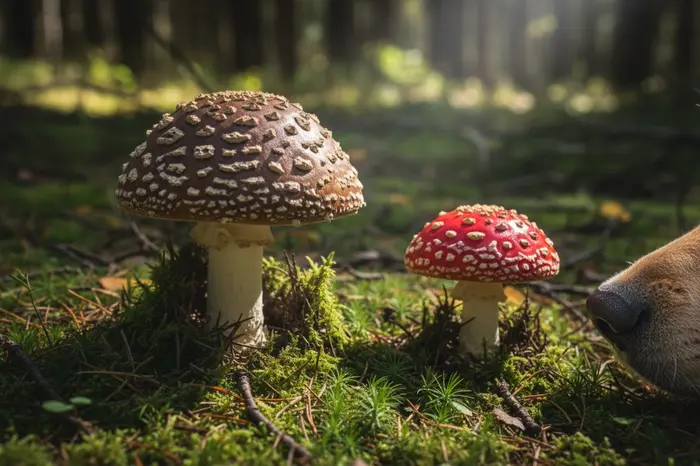
This guide compares Amanita pantherina formats and preparations to help you choose the most effective option based on your health goals and lifestyle.
Pantherina vs muscaria: the risk factors side by side
The two species share the same core compounds — muscimol, ibotenic acid, and muscarine — but they differ sharply in how much, how consistently, and how abruptly those compounds act. The table below summarises the practical differences that matter for safety. None of these figures should be read as exact thresholds; they describe tendencies documented in mycotoxicological reviews (Michelot & Melendez-Howell, 2003, Mycological Research, PMID 12733432).| Factor | Amanita pantherina | Amanita muscaria |
|---|---|---|
| Total alkaloid load | Higher — some samples 3–5× greater | Lower, baseline reference |
| Batch-to-batch variability | High | Moderate |
| Onset predictability | Can act more abruptly in some people | Generally easier to anticipate when quality is stable |
| Practical safety margin | Narrower | Wider |
| Switching species | Dose recalibration required — never copy a muscaria dose | — |
Why pantherina is considered higher risk
How It Works
The core issue is not only strength. The bigger issue is unpredictability. With pantherina, small changes in raw material, processing quality, and user sensitivity may create disproportionately strong effects. That narrows the practical safety margin. In other words, the distance between mild and problematic response can be smaller than people expect, especially when quality control is weak. Because muscimol binds GABA-A receptors with high affinity, a modest increase in compound density does not produce a modest increase in effect — it can push the response from calming into disorienting. That non-linear relationship is the real reason pantherina is treated as a higher-discipline category rather than simply a "stronger mushroom."Potency variability: what drives it – Amanita pantherina
Important Considerations
Mushroom chemistry is affected by growth conditions, harvest timing, drying quality, storage stability, and product standardization. Two products labeled with the same species may not behave the same in real-world use. If material is poorly processed or inconsistently dried, the response profile becomes less predictable. This is one reason experienced users prioritize supplier transparency and batch consistency over marketing claims. Forensic analyses have shown the muscimol-to-ibotenic-acid ratio can differ not only between mushrooms but between the cap and stem of a single fruiting body, and with the moisture content at harvest. In practice this means a gram from one jar is not pharmacologically identical to a gram from another, which is exactly why weight alone is a poor proxy for dose.Pantherina versus muscaria in practical terms
Muscaria is often viewed as the more manageable option for routine use discussions because response curves can be easier to anticipate when quality is stable. Pantherina may act more abruptly in some individuals. That does not make one species universally good or bad. It means risk management standards should be stricter with pantherina, and assumptions copied from muscaria experience can be misleading. The most common error of all is to treat the two as interchangeable by weight. Clinical intoxication cases from pantherina tend to be more severe than those from muscaria at equivalent ingested amounts, which is consistent with its higher compound density and a reminder that "same genus" does not mean "same dose."Common mistakes that increase risk
The first mistake is treating pantherina like a stronger version of muscaria without changing safety discipline. The second is using unverified material with unknown processing history. The third is combining with alcohol or sedative substances, which stack with muscimol's inhibitory GABA-A activity and can deepen sedation unpredictably. The fourth is experimenting in uncontrolled settings where support is unavailable. A fifth, often overlooked, is re-dosing too early because a delayed onset is mistaken for "nothing happening." All of these mistakes are preventable and account for many avoidable incidents.Warning signs of excessive response
Concerning signs may include strong disorientation, impaired coordination, confusion, agitation, marked sedation, and persistent nausea or vomiting. Severe cases documented in the toxicology literature can include delirium and, rarely, seizures (Satora et al., 2005, Toxicon, PMID 15904716). If symptoms escalate or feel unsafe, seek emergency medical support instead of waiting for spontaneous improvement. Fast action is safer than delayed action when neurologic symptoms are present, and it helps to be able to tell responders what was taken and roughly how much.Who should avoid pantherina entirely
People with psychiatric instability, seizure history, major cardiovascular risk, pregnancy, breastfeeding, or complex medication regimens should avoid high-risk self-experiments. Anyone already using central nervous system active medications — sedatives, benzodiazepines, certain antidepressants — should treat interaction potential as serious. Because trace muscarine can stimulate muscarinic receptors, people with cardiac arrhythmia or those on anticholinergic drugs warrant particular caution. If uncertainty exists, professional medical review is the responsible path.How to reduce avoidable risk
Start with education, not with assumptions. Use only clearly labeled, tested products from transparent suppliers, ideally with third-party testing for muscimol content. Avoid poly-supplement experiments and avoid any alcohol co-use. Keep environment controlled and never use before driving or high-risk tasks. Store products in secure containers away from children and pets. These basic controls reduce incident probability significantly.Why product format matters
From a safety perspective, standardized and clearly packaged formats are easier to handle than loose, poorly labeled material. Capsules can reduce measuring error and offer dose standardization, which matters more for a species with documented potency variability. Properly labeled fruiting body and powder products may still be used, but only with strict handling discipline and accurate tools. Consistency and traceability are more important than novelty.Risk communication inside the household
If pantherina products are stored at home, every adult should understand that these are high-risk materials, not casual supplements. Use clear labels, dedicated storage, and written handling rules. Do not allow unidentified containers, unlabeled transfer jars, or mixed-product storage. If someone else has access to your cabinets, explain the rules directly and verify they are followed. Households with guests, shared kitchens, or frequent travel should apply stricter controls because routine breaks create risk spikes. Safety failures often start with communication failures. A shared protocol is as important as product quality because it prevents accidental misuse by people who did not make the original purchasing decision.Bottom line
Amanita pantherina requires a higher technical safety standard than many people assume. The central risk is potency variability plus human response variability. If you approach this category at all, do it with strict quality controls, conservative decision making, and a clear emergency mindset. In safety-critical categories, discipline is not optional.Relevant products for informed comparison and safer selection
1. Amanita Pantherina Capsules2. Amanita Pantherina Fruits
3. Amanita Pantherina Powder
4. Amanita Muscaria CapsulesView all options at Amanita Muscaria Store.
Explore Amanita pantherina at Amanita Store
Visit amanitamuscariastore.online to browse our full range of lab-tested, wild-harvested products. Free shipping on orders over €50.
Frequently Asked Questions
Is Amanita pantherina really stronger than Amanita muscaria?
Generally yes. Mycotoxicological analyses report that pantherina can carry substantially higher total concentrations of muscimol and ibotenic acid — some samples three to five times the alkaloid load of muscaria. But the more important point is variability: pantherina's compound levels swing more between batches, so its effect is less predictable. Treating it as simply "muscaria but stronger" understates the real risk.
Why is potency so variable in pantherina?
Because the active-compound content depends on growth conditions, harvest timing, moisture at harvest, drying quality, and storage. The muscimol-to-ibotenic-acid ratio can differ even between the cap and stem of a single mushroom. Two products labelled with the same species and weight may therefore behave differently, which is why supplier transparency and batch testing matter more than the number on the label.
What are the warning signs of an excessive response?
Strong disorientation, impaired coordination, confusion, agitation, marked sedation, and persistent nausea or vomiting are all concerning. The toxicology literature also documents delirium and, rarely, seizures in severe cases. If symptoms escalate or feel unsafe, seek emergency medical care rather than waiting — fast action is safer than delayed action when neurological symptoms appear.
Can I use my Amanita muscaria dose as a guide for pantherina?
No. This is one of the most dangerous assumptions. Because pantherina is more concentrated and more variable, an equivalent weight can produce a much stronger effect. Dose recalibration is required whenever switching species, starting from the smallest possible amount with a full observation window before considering any change.
Who should avoid Amanita pantherina entirely?
People with psychiatric instability, a seizure history, significant cardiovascular risk, pregnancy or breastfeeding, or complex medication regimens — especially central-nervous-system-active drugs — should avoid high-risk self-experimentation. Trace muscarine also makes caution sensible for those with arrhythmia or on anticholinergic medication. When in doubt, professional medical review is the responsible choice.
Related Articles
Sources
- Michelot D, Melendez-Howell LM. Amanita muscaria: chemistry, biology, toxicology, and ethnomycology. Mycological Research. 2003. PMID 12733432
- Satora L, et al. Fly agaric (Amanita muscaria) poisoning. Toxicon. 2005. PMID 15904716