




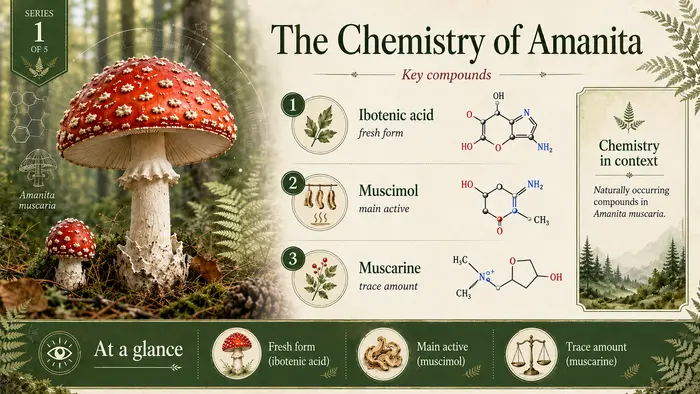
Amanita muscaria contains muscimol and ibotenic acid as its primary psychoactive compounds; muscimol acts as a GABA-A receptor agonist producing sedative and anxiolytic effects, while ibotenic acid is a prodrug that converts to muscimol upon drying or decarboxylation.
The precursor of muscimol is ibotenic acid. In freshly picked fly agaric, the amount of ibotenic acid exceeds the amount of muscimol by roughly 60 times. Only during drying and decarboxylation does ibotenic acid lose a carboxyl group and become muscimol. This single reaction explains why a fresh cap and a properly dried cap behave almost like two different substances — and why traditional cultures never ate the mushroom raw.
The core compounds at a glance
Before looking at individual effects, it helps to see how the four main molecules differ. Each targets a different receptor system, and their balance shifts dramatically with preparation. Michelot and Melendez-Howell, in the most cited chemical review of the species, describe this profile in detail (Michelot & Melendez-Howell, 2003, Mycological Research, PMID 12733432).| Compound | Receptor target | Primary effect | Notes on preparation |
|---|---|---|---|
| Ibotenic acid | NMDA / glutamate agonist (excitatory) | Stimulation, tension, nausea | Dominant in fresh mushroom; converts to muscimol when dried |
| Muscimol | GABA-A agonist (inhibitory) | Calm, sedation, deep sleep, anxiolysis | Concentration rises sharply after low-temperature drying |
| Muscazone | Weak CNS activity | Mild mood and emotional modulation | Forms slowly from oxidation of ibotenic acid |
| Muscarine | Peripheral muscarinic acetylcholine | Salivation, sweating (toxic in quantity) | Present only in trace amounts in A. muscaria |
Muscimol and sleep – Amanita muscaria
Muscimol promotes deep sleep, helps to overcome anxiety, creates calmness, supports the release of fears, improves thinking and memory, and reduces the desire to smoke and drink alcohol.Muscimol actively interacts with GABA (1) receptors and stimulates their function. GABA is the main inhibitory neurotransmitter that transmits signals between neurons, and muscimol binds the GABA-A receptor directly rather than merely encouraging the body to make more GABA (Johnston, 2014, Neurochem Res, PMID 24525044).
The parasympathetic nervous system is responsible for the control of organs in a state of rest and relaxation. When GABA binds to receptors, neuronal excitation falls and overall activity of the nervous system decreases. Thanks to this stimulation, you become calmer, which is why muscimol settles the nervous system rather than stimulating it.
In a German study in 1996 (3), muscimol was shown to increase the proportion of deep, slow-wave sleep several times over. Deep sleep is the stage during which the body accumulates the substances it needs for full functioning, synthesizes amino acids, runs its repair and regeneration processes, and produces somatotropic hormone (growth hormone). Because so much physical recovery is compressed into this phase, even a modest shift toward deeper sleep can change how rested a person feels the next day.
Muscimol also influences the production of dopamine, norepinephrine, and serotonin. This is felt as an uplifted mood, more confidence and courage, and a reduction in the background hum of anxiety.
Muscimol improves mood – Amanita muscaria
In 1989, a study (2) showed that muscimol reduces the activity of MAO.MAO (monoamine oxidase) is the enzyme responsible for breaking down dopamine, serotonin, and norepinephrine.
Slowing MAO leaves more of these monoamines in circulation. They drive feelings of happiness, satisfaction, motivation, and attention — the more of them remain available, the steadier and brighter the mood tends to be. This is the same broad mechanism that several pharmaceutical antidepressants exploit, though muscimol's primary action remains at the GABA-A receptor rather than on monoamine metabolism. The mood lift people report is therefore best understood as a secondary, supportive effect layered on top of the core calming action.
Clarity of thinking and muscimol
In the same 1989 study, muscimol was also shown (2) to decrease the activity of acetylcholinesterase, the enzyme that breaks down acetylcholine.Acetylcholine is a neurotransmitter that facilitates the transmission of signals from one nerve to another and is central to attention and learning. The more acetylcholine remains available, the sharper thinking tends to be.
The combination is what users describe most often: a quiet nervous system paired with preserved mental clarity. Rather than the foggy heaviness of a sedative, the experience is closer to a calm, uncluttered focus in which problems that felt tangled start to look solvable. For a deeper look at how the two main molecules differ in this respect, see our breakdown of ibotenic acid vs muscimol.
Muscimol improves memory
Several studies have indicated an effect of muscimol on memory. Muscimol protected the hippocampus from natural cell death, preventing impairment in learning and memory (4). Small doses of muscimol have been shown to significantly improve memory and learning ability in animal models, while larger amounts produced the opposite effect (6). This dose-dependent reversal is one of the most important points in the whole chemistry of the mushroom: the same molecule that supports memory at a microdose can impair it at a high dose. It is the clearest argument for treating Amanita muscaria as a substance where less is genuinely more.Muscimol and smoking
In a 2010 study, injecting muscimol into the insula reduced activity in that brain region through muscimol's inhibitory action, which in turn reduced the urge to smoke (8). The insula is a hub for cravings and interoceptive "urge" signals, so quieting it lowers the felt intensity of a craving rather than relying on willpower alone. While the study used direct injection in an experimental setting, it points to a plausible mechanism behind the anecdotal reports of reduced cravings during microdosing.Muscimol and alcohol
Muscimol and alcohol act on the same neurotransmitter system — GABA. When muscimol occupies the GABA-A receptor, alcohol has less unoccupied receptor space to act on, because muscimol is already binding there. This overlap is why some people exploring Amanita muscaria report a reduced pull toward alcohol: the receptor "reward" alcohol normally produces is partly pre-occupied. It is also a reason for caution — combining the two is never advisable, since both push the nervous system in the same inhibitory direction and the effects can stack unpredictably.How drying rewrites the chemistry
The most important chemical event in the whole life cycle of a fly agaric preparation is decarboxylation. In the fresh mushroom, the unstable, irritating ibotenic acid dominates. Applying gentle heat — drying at temperatures that stay below roughly 75°C — strips a carboxyl group from ibotenic acid and converts it into the far more stable muscimol (Tsujikawa et al., 2006, Forensic Sci Int, PMID 16442251). Too little heat leaves harsh ibotenic acid behind; too much heat can degrade muscimol itself. This is why preparation is not a cosmetic step but the reaction that determines what the final product actually does, and why correct preparation and dosing of Amanita muscaria matters so much.What the science still does not know
For all its long history, Amanita muscaria remains under-studied by modern standards. Much of the human evidence is anecdotal or drawn from older animal work, and the precise pharmacokinetics of muscimol in people — how quickly it is absorbed, how it is cleared, how individual GABA-A receptor variation changes the response — are still poorly mapped. There are no large controlled clinical trials on microdosing. That gap is a reason for honesty rather than dismissal: the chemistry is genuinely interesting, but the most accurate statement is that we understand the molecules better than we understand their long-term effects in humans. Find out how it can benefit your health:1.Amanita muscaria capsules
2.Amanita muscaria Premium (small mushrooms)
3.Amanita muscaria Grade A (flat mushrooms)
4.Amanita muscaria powder
Frequently Asked Questions
What is the difference between ibotenic acid and muscimol?
They are chemically linked but behave oppositely. Ibotenic acid, dominant in fresh mushrooms, is an excitatory glutamate-receptor agonist that can cause tension and nausea. Muscimol, formed when ibotenic acid is decarboxylated during drying, is an inhibitory GABA-A agonist that produces calm and sedation. Drying converts most of the ibotenic acid into muscimol, which is why dried and fresh fly agaric feel so different.
Why must Amanita muscaria be dried before use?
Drying drives the decarboxylation of ibotenic acid into muscimol. Fresh caps are high in ibotenic acid, the harsher and more nausea-inducing compound, while properly dried caps are richer in the gentler muscimol. Drying is typically done below about 75°C: enough heat to convert the compounds, but not so much that the muscimol itself degrades. This is the single step that most determines a preparation's effect.
How does muscimol calm the nervous system?
Muscimol binds directly to GABA-A receptors, the brain's main inhibitory switch (Johnston, 2014, PMID 24525044). When these receptors are activated, neuronal excitation drops and overall nervous-system activity decreases. Unlike compounds that simply encourage the body to make more GABA, muscimol mimics GABA at the receptor itself, which is why its calming, sleep-promoting effect is direct and relatively predictable.
Is the mood and memory effect the same at every dose?
No — and this is critical. Animal studies show small doses of muscimol can support memory and learning, while large doses impair them (effect 6 above). The mood lift tied to slowed MAO activity is also a low-dose phenomenon. Amanita muscaria is a substance where more is not better; the supportive effects belong to the microdose range, and high doses shift the chemistry toward impairment and intoxication.
Is muscarine in Amanita muscaria dangerous?
Despite giving the mushroom its name, muscarine is present in red Amanita muscaria only in trace amounts — far too little to cause the muscarinic poisoning seen with some other fungi. The compounds that matter for both effects and risk are muscimol and ibotenic acid, not muscarine. That said, dose and correct preparation remain essential, and anyone with a medical condition should consult a professional first.
Related Articles
- Amanita muscaria Microdosing Guide
- Amanita muscaria Effects and Safety
- How to Use Amanita muscaria Tincture
- Ibotenic Acid vs Muscimol Explained
- How Amanita Compounds Affect the Body
- Amanita Regalis: Effects & Traits
- Amanita Regalis: Habitat & ID Guide
- Amanita Muscaria vs Pantherina
- Amanita Muscaria vs Psilocybin Mushrooms
- Interesting facts about fly agaric you didn't know
- Amanita's Life Cycle and Ecosystem Role in Nature
- Fly agaric and ecology: how it cleanses the soil
Sources
- Michelot D, Melendez-Howell LM. Amanita muscaria: chemistry, biology, toxicology, and ethnomycology. Mycological Research. 2003. PMID 12733432
- Tsujikawa K, et al. Analysis of hallucinogenic constituents in Amanita mushrooms. Forensic Sci Int. 2006. PMID 16442251
- Johnston GAR. Muscimol as an ionotropic GABA receptor agonist. Neurochem Res. 2014. PMID 24525044